Application Programming Interface
Table of Contents
- Introduction
- The Problem (Language & Translator Analogy)
- Definition of an API
- Core Concepts of API Communication
- Message Format
- Medium (Transport Layer)
- Why Interfaces Matter in Software Development
- Abstraction & Simplicity
- The Problem Without an Interface
- API Types — Deep Dive with Examples
- 5.1 Library / SDK APIs
- Medium & Format
- Examples
- 5.2 OS APIs
- Medium & Format
- Examples
- 5.3 Web APIs
- Medium & Format
- API Styles:
- REST
- GraphQL
- gRPC
- WebSocket
- Code Examples
- 5.4 Database APIs
- Medium & Format
- Drivers vs ORMs
- Examples
- 5.1 Library / SDK APIs
- The Full Picture
- Comparative Table of API Types
- Key Insight: Medium vs Format
- Conclusion
- APIs as Translators Between Systems
- References
Understanding APIs
The Problem
Let's say you travel to a foreign country, and you can't speak the local language — but you need to do business, buy things, eat, and get around.[1]
You have two options:
Option 1 — Learn the language. This takes time. How long depends on the learning curve of that language. Until you're fluent, you're stuck.
Option 2 — Hire a translator. The translator speaks your language and the country's language. You tell the translator your intent, and they transmit it to whoever you need to communicate with — and bring the response back to you.
That is exactly the problem an API solves.
Definition
An API (Application Programming Interface) is an interface that facilitates communication between two pieces of software , for instance software A and B .[2]
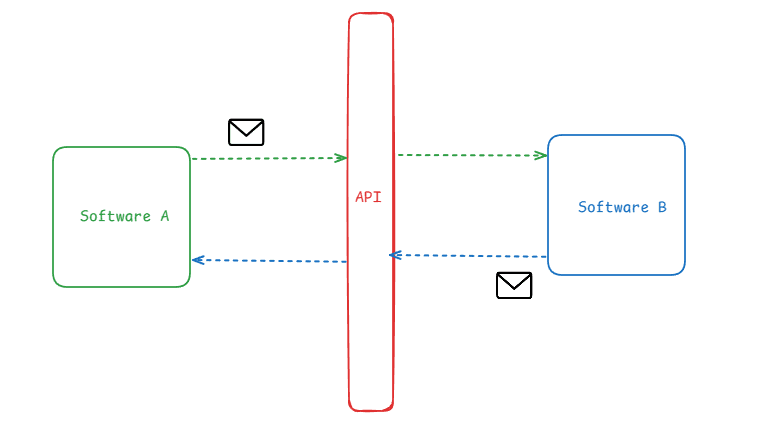
Communication is the act of sending messages / data across a medium.
This means an API has to deal with two things:
- Message Format — how the data is structured (e.g. JSON, XML)
- Medium — how the data travels (e.g. HTTP, memory, sockets)
Why Do We Need an Interface In Software Developement ?
The short answer: because you don't need to understand how something works in order to use it. [3] If software A want to use B , software doesnot need to know how B internally works . the concept of interface are also used in hardware development. The next section illustrate which problem the concept interface solve.
The Problem Without an Interface
Imagine if every time you wanted to use a feature of your operating system, you had to write the code that controls the hardware directly. Want to save a file? You'd need to know:
- Which physical sectors of the hard drive to write to
- How the file system is structured at the binary level
- How to talk to the disk controller chip
That's obviously impossible for most developers. An interface hides all that complexity and gives you a simple handle: fs.writeFile('notes.txt', content).
I think the above section , makes it clear , how useful Application Programming Interface is in developement . Now let us speak about the differents of API’s with example .
API Types — Deep Dive with Examples
Every API communication involves two inseparable components: what is being sent, and how it travels. In this section , we are going to discuss about the different types of API with their various format and medium of transport .
1. Library / SDK APIs
You call functions from a package or language built-in directly inside your code. No network involved.[4]
- Medium: Memory — the call happens inside the same running process
- Format: Native language types — objects, arrays, strings, numbers (no serialization needed)
Since everything happens in-process, there is no network hop, no HTTP, no JSON. You pass a JavaScript object and get a JavaScript object back — the language itself is the format.
Examples:
- Array.sort() — JavaScript standard library
- pandas.read_csv() — Python data library
- stripe.charges.create() — Stripe SDK
2. OS APIs
Your application asks the operating system for access to hardware or system resources — file system, camera, network, memory.[5]
- Medium: System calls — a controlled bridge between your app and the OS kernel
- Format: Binary / native OS structures — the OS speaks in low-level data structures, not JSON
You never talk to the hardware directly. The OS exposes an interface — a set of system calls — and manages the hardware on your behalf.
Examples:
- Reading a file: fs.readFile('notes.txt') → OS reads from disk and returns bytes
- Accessing the camera: navigator.mediaDevices.getUserMedia() → OS hands you a media stream
- Sending a desktop notification
// Your app asks the OS (via the browser's OS API bridge) for camera access
// Medium: system call. Format: binary media stream
const stream = await navigator.mediaDevices.getUserMedia({ video: true });
3. Web APIs
Two separate systems — often on different machines — communicate over a network. This is the most common type of API you'll work with as a developer. [6]
- Medium: Internet over HTTP / HTTPS (or WebSocket for real-time)
- Format: JSON (most common today), XML (older/enterprise), Binary like Protobuf (high-performance)
Web APIs come in several styles — each making different trade-offs:
| Style | Medium | Format | Best For |
|---|---|---|---|
| REST | HTTP/HTTPS | JSON | Standard CRUD apps, most backends |
| GraphQL | HTTP/HTTPS | JSON | Flexible queries, avoid over-fetching |
| gRPC | HTTP/2 (TCP) | Protobuf (binary) | Microservices, high-performance |
| WebSocket | Persistent TCP | JSON or binary | Real-time: chat, live dashboards |
// REST — Medium: HTTPS, Format: JSON
// You send an HTTP request, you get JSON back
fetch('https://api.github.com/users/octocat')
  .then(res => res.json())   // parse the JSON format
  .then(user => console.log(user.name));`

// WebSocket — Medium: persistent TCP connection, Format: JSON
// No request/response cycle — the server can push data at any time
const socket = new WebSocket('wss://chat.myapp.com');
socket.onmessage = (event) => {
  const message = JSON.parse(event.data); // parse incoming JSON
  console.log(message.text);
};
4. Database APIs
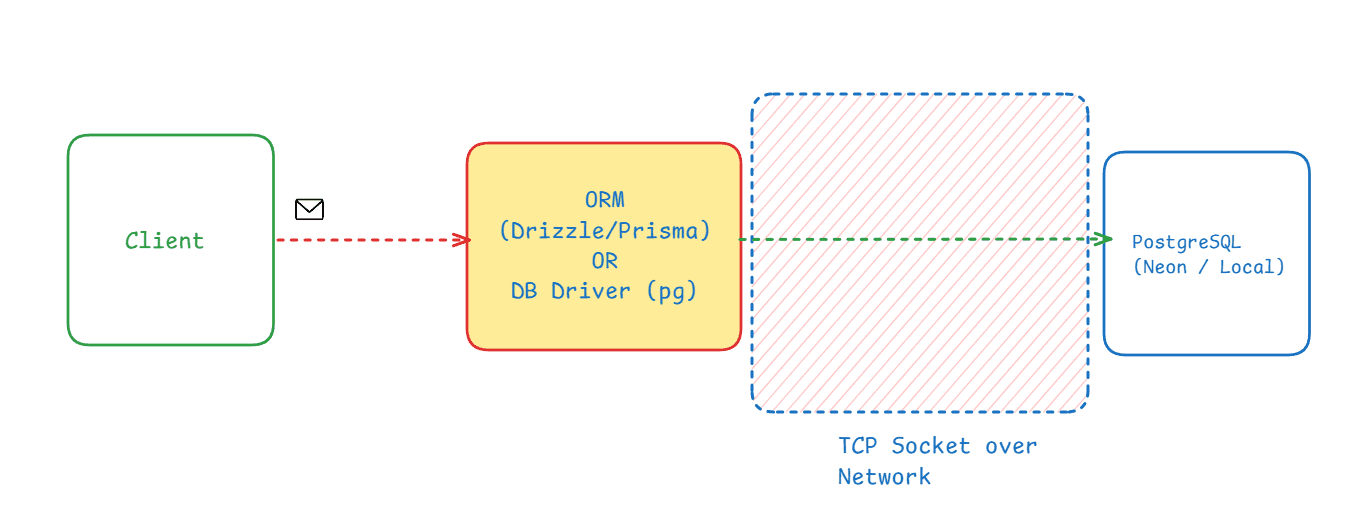
Your backend communicates with a database to read and write data. The database lives either on the same machine or a remote server.[7]
- Medium: TCP socket — a direct network connection to the database process
- Format: SQL statements (text protocol) or binary wire protocols (e.g. PostgreSQL wire protocol)
You rarely speak to the database directly — you use a driver or an ORM that wraps the raw protocol into something readable.
Examples:
- Data seeding and Migration, read this article to understand those terms
- Raw driver: pg sends SQL text over TCP, gets back binary rows
- ORM: Drizzle/Prisma translates your code into SQL, then hands it to the driver
// ORM layer — you write code, Drizzle translates to SQL, driver sends over TCP
// Medium: TCP socket. Format: SQL → PostgreSQL wire protocol
const users = await db.select().from(usersTable).where(eq(usersTable.id, 1));
The Full Picture
Every API type answers the same two questions differently:
| API Type | Medium | Format |
|---|---|---|
| Library / SDK | In-process memory | Native language types |
| OS API | System call (kernel) | Binary / OS structures |
| Web API (REST) | HTTP/HTTPS | JSON |
| Web API (WebSocket) | Persistent TCP | JSON / Binary |
| Database API | TCP socket | SQL / Wire protocol |
The medium is the road. The format is the language.
The API is the translator that makes it all work.
REFERENCES
[1] Merriam-Webster. "Communication." Merriam-Webster Dictionary, 2024. https://www.merriam-webster.com/dictionary/communication
[2] MDN Web Docs. "Introduction to Web APIs." Mozilla Developer Network, 2024. https://developer.mozilla.org/en-US/docs/Learn/JavaScript/Client-side_web_APIs/Introduction
[3] Gamma, E., Helm, R., Johnson, R., Vlissides, J. "Design Patterns: Elements of Reusable Object-Oriented Software." Addison-Wesley, 1994. https://en.wikipedia.org/wiki/Design_Patterns
[4] npm Documentation. "About packages and modules." npm, Inc., 2024. https://docs.npmjs.com/about-packages-and-modules
[5] Linux Foundation. "The Linux Kernel API." kernel.org, 2024. https://www.kernel.org/doc/html/latest/core-api/index.html
[6] Fielding, R. "Architectural Styles and the Design of Network-based Software Architectures." University of California, Irvine — Doctoral Dissertation, 2000. https://ics.uci.edu/~fielding/pubs/dissertation/rest_arch_style.htm
[7] PostgreSQL Global Development Group. "PostgreSQL Frontend/Backend Protocol." postgresql.org, 2024. https://www.postgresql.org/docs/current/protocol.html
Thanks for reading
Alain Ngongang